 Sedona City Guide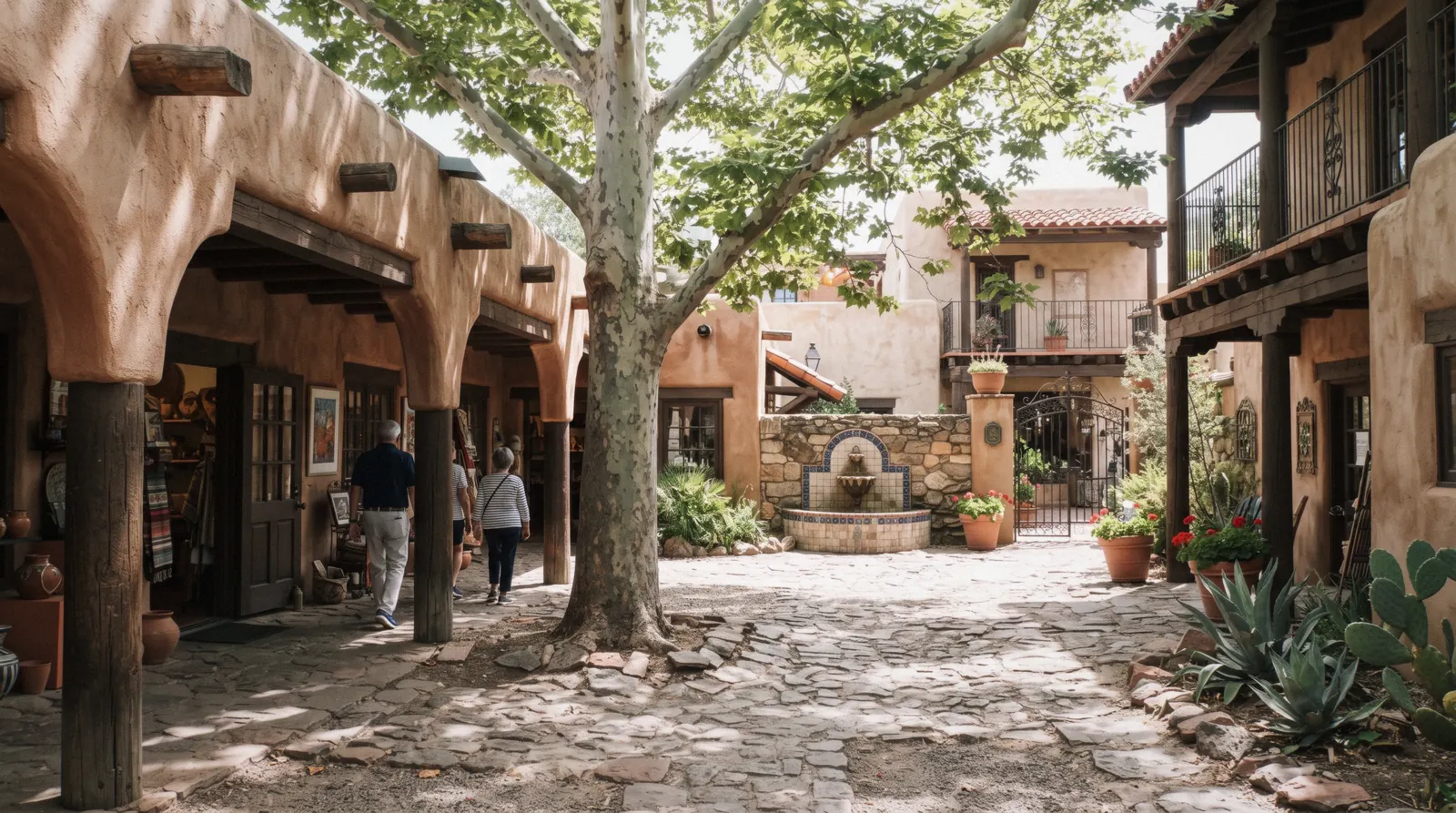
Tlaquepaque
Tlaquepaque is the Spanish-colonial-style arts and shopping village on SR-179 that most visitors assume is centuries old and is not: it was built from open ground in the 1970s, named after and modeled on a market town near Guadalajara, Mexico, and laid out around a grove of sycamores that predates the buildings themselves. This page covers the hours, the free parking, the chapel on the property and what kind of stop this actually is, an arts and dining complex rather than a historic landmark; the rest of Uptown is on the things to do in Sedona list, and the genuinely historic stop nearby is the Sedona Heritage Museum. How a shopping stop fits against a Sedona red-rock itinerary is laid out on the homepage.
Quick answer Hours, price, parking, what it is, in three lines
Tlaquepaque is open Monday to Thursday 10 am to 5 pm and Friday to Sunday 10 am to 6 pm, free to enter, with free parking in every lot on the property, closed only on Thanksgiving and Christmas.
Key takeaways
- It is a shopping and gallery complex, not a historic site: built from open ground in the 1970s by developer Abe Miller and architect Bob McIntyre, modeled on a market town near Guadalajara, covered in what Tlaquepaque actually is
- Individual shops keep their own hours inside the village's general opening window, so a specific gallery can be closed while the courtyards are open; call ahead for a named shop
- The Chapel at Tlaquepaque is a working wedding venue booked in advance, not a walk-in sight like the Chapel of the Holy Cross across town
- A 6-stop Sedona sightseeing van tour includes shopping time on its route if you want it folded into a wider morning rather than a standalone visit
Key facts
Opening hours
| Monday–Thursday | 10:00–17:00 |
|---|---|
| Friday–Sunday | 10:00–18:00 |
Closed Thanksgiving and Christmas
Planning it
- Time needed
- Not stated by the property; our routing: an hour to browse, longer with lunch or a gallery stop
- Book ahead
- Optional — walk-up usually fine
- Address
- 336 SR-179, Sedona, AZ 86336
There is nothing to buy to enter Tlaquepaque; the village and its parking are free, priced from the property's own site on 9 September 2026. The only products on the market are general Sedona sightseeing tours that pass through it as one stop among several.
Are you driving here and parking yourself, or do you want it folded into a guided morning around town?
| Option | Price | Includes | Cancel | Book |
|---|---|---|---|---|
| Walk in on your ownEveryone. There is no ticket, membership or paid entry of any kind for the village itself | Free | Free entry to the courtyards, shops and galleries; free parking in every lot | Nothing to cancel | Official site |
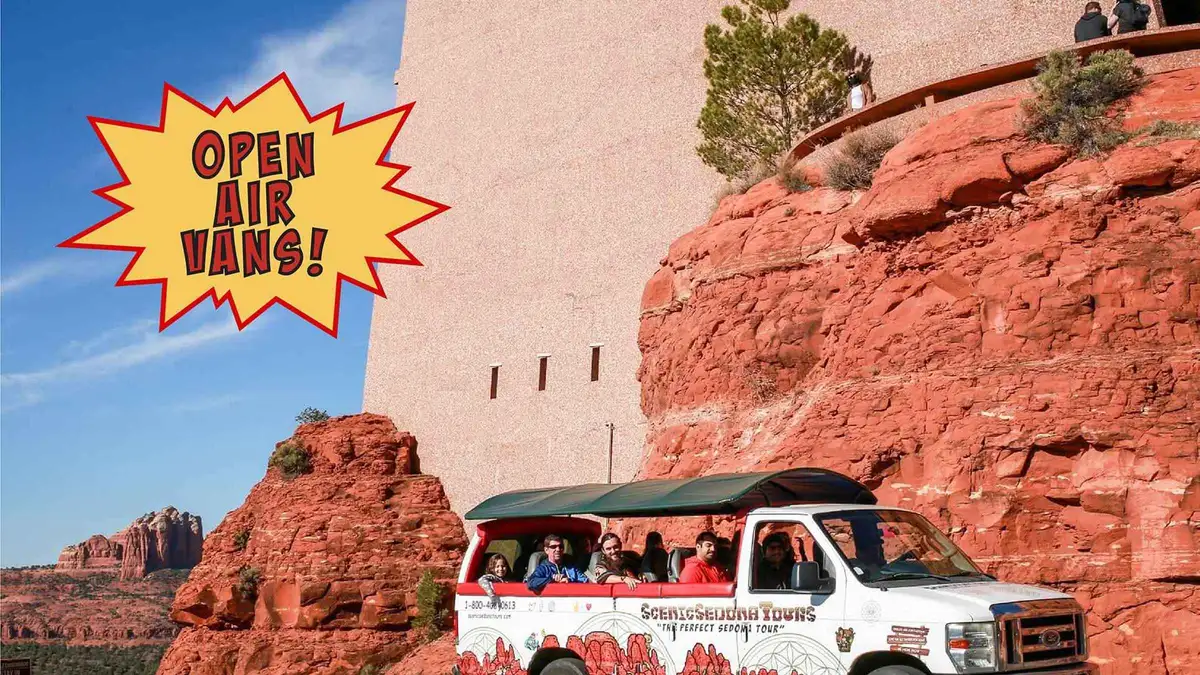
| Sedona highlights van tour, 6 stopsVisitors who want Tlaquepaque folded into a wider guided morning rather than driving and parking here on their own | $126 | 5.5-hour open-air van tour with a local guide, shopping and eating time at several stops | Set by the operator at booking | Check Availability |
| Magic of Sedona sightseeing tour, 2 hA shorter narrated overview if two hours is all the sightseeing time you have; a specific Tlaquepaque stop is not guaranteed on every departure | $63 | Open-air bus tour with photo stops covering red rock geology and regional history | Set by the operator at booking | Check Availability |
Tlaquepaque charges nothing to enter and nothing to park; the fee questions in Sedona belong to the state parks and Forest Service trailheads, not here. The two tours above sell narration and transport around town, not access to the village, which is open to anyone who drives up.
Sedona sightseeing tours that stop at Tlaquepaque
These are general town tours with shopping time, not tickets into the village, which is free and open to anyone. Prices as listed in Q3 2026.
 from $126
Most-reviewed sightseeing tour on this page (212 reviews)
from $126
Most-reviewed sightseeing tour on this page (212 reviews) Sedona: Open-Air Van Tour with a Local Guide and 6 Stops
A longer open-air van circuit with six stops mixing sightseeing, shopping and food rather than a single scenic loop. Suits visitors who want to break up the drive with time on foot at each stop.
Check Availability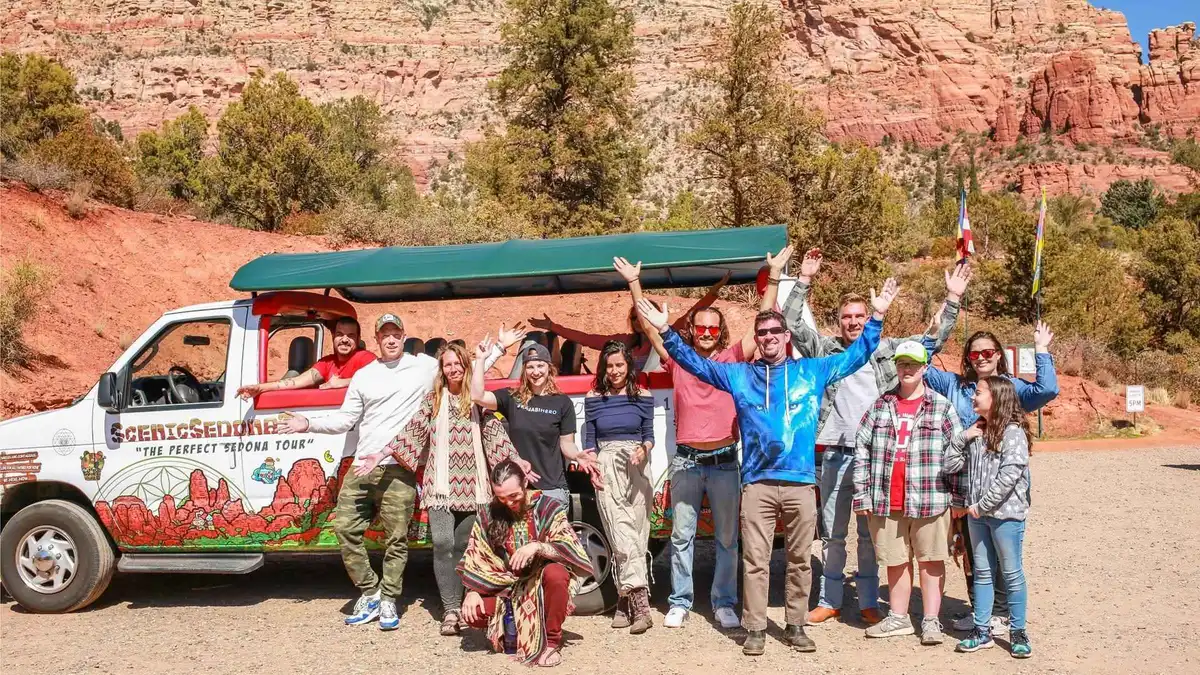 from $63
Sedona: The Magic of Sedona Highlights Tour
An open-air bus sightseeing loop with a local guide covering Sedona's geology, vortex claims, and history across several photo stops. Suits visitors who want an overview of the whole town on one short ride.
Check Availability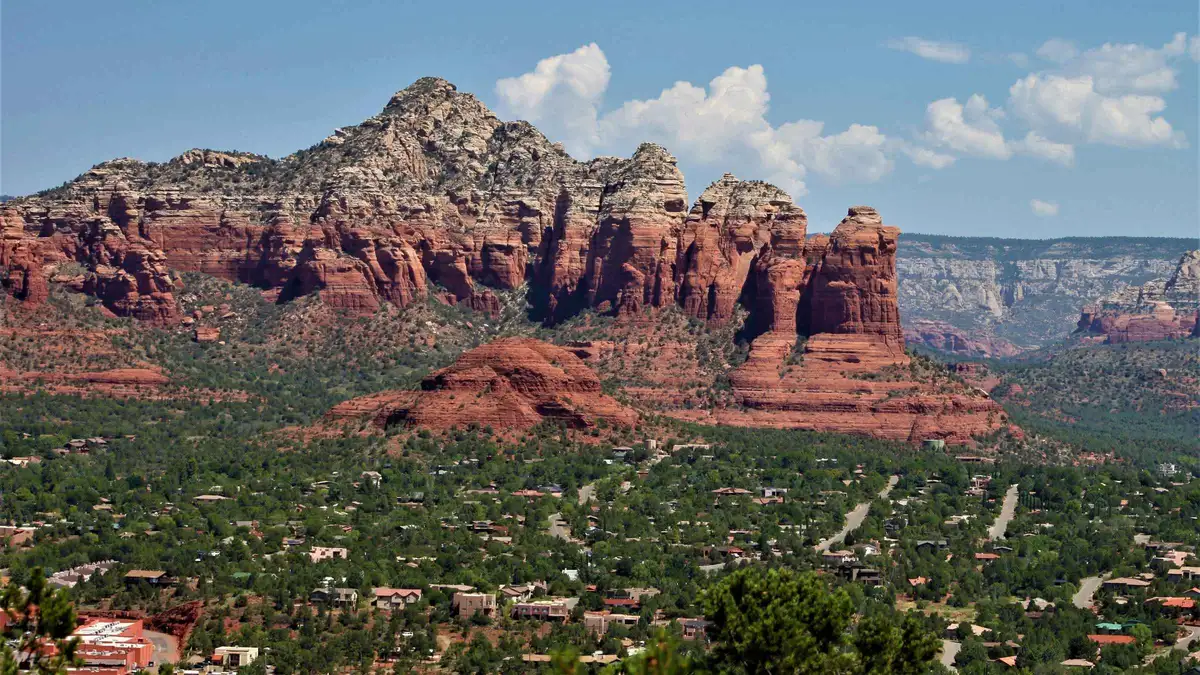 from $49.95
Sedona: Hi-Points Van Tour
A short, low-cost run to Sedona's most-visited viewpoints, positioned by the operator as a quick highlights reel rather than a full-day itinerary. Suits travelers with limited time who want the classic photo stops fast.
Check AvailabilityPrices, ratings and details are the platform's own, checked in Q3 2026; dollar figures are the listed prices — the platform bills in your account's currency.
What Tlaquepaque Actually Is: a 1970s Arts Village, Not a Historic Site
The name and the architecture read as centuries old. Neither is: Tlaquepaque is a purpose-built shopping and gallery complex from the 1970s, and its own history page is upfront about that.
Built by Abe Miller in the 1970s, when Sedona had almost nothing
Nevada businessman and philanthropist Abe Miller founded Tlaquepaque in the 1970s, when Sedona had minimal development, working with architect Bob McIntyre on the design [tlaq.com/history]. The two men traveled through Mexico studying traditional architecture and gathering authentic materials, hand-forged ironwork, carved wooden doors, Talavera tiles, to build an environment rooted in Mexican village character rather than a themed stage set.
Named for a market town near Guadalajara
The design was inspired directly by San Pedro Tlaquepaque, a market town near Guadalajara, Mexico. The village's own history page translates the name as meaning "the best of everything" in an ancient Aztec language, though that is the property's own gloss on the name rather than an independently sourced etymology, and is worth taking as marketing history rather than a settled linguistic fact.
The sycamore grove the village was built around
A grove of century-old sycamore trees along Oak Creek predates the development and became central to the site's character; the courtyards were laid out around the existing trees rather than the trees being planted afterward to soften a new building [tlaq.com/history]. It is the one genuinely old thing on the property, and it is why the shade inside the village feels different from the open SR-179 frontage outside it.
Tlaquepaque North, 2017
Tlaquepaque North opened in 2017 across the street at 313 SR-179, extending the original village's pedestrian-friendly layout and its focus on art rather than chain retail. It has its own free parking lot, separate from the original property's lots.
What was here before: open ground, not an older village
It is worth repeating plainly, since the property's own marketing leans into the illusion: there was no earlier Mexican-village settlement on this land that Tlaquepaque restored or preserved. Sedona in the early 1970s was a small, thinly developed town, and the site Miller chose was undeveloped ground next to Oak Creek. Everything Spanish-colonial about the property, the arches, the ironwork, the tile, was designed and built new, in one era, to evoke a place four hours south across the border rather than to restore anything that stood here already.
That is not a criticism of the result, which is why the village works as well as it does photographically; it is simply the honest answer to how old the buildings actually are.
A Shopping and Gallery Complex, Told Straight
This page will not name a specific shop, restaurant or gallery unless a citable source backs the claim; the village's own site lists more than 50 specialty shops, galleries and eateries across the original property and Tlaquepaque North combined, split roughly into 28 shops, 13 galleries and 9 food-and-drink venues [tlaq.com]. That is the honest way to describe the mix without repeating a promotional list of business names this page cannot independently verify or keep current as tenants change. What is worth knowing before you go: it is a private commercial property, not a public plaza, and every business inside it sets its own hours within the general 10-to-5 or 10-to-6 window.
The mix runs from Southwestern jewelry and rug dealers to fine-art galleries and a handful of sit-down restaurants, but naming a specific business by name here would go stale the moment a lease changes, which is common in a property this size. The village's own directory on tlaq.com is the current source for exactly who is trading this month. Prices inside range widely by design, from inexpensive souvenirs to originals in the fine-art galleries, and nothing on this page should be read as a price guide for what is, in the end, a private retail property.
Why It Calls Itself an Arts Village
Galleries make up roughly a quarter of the businesses on the property, more than the food-and-drink count, which is unusual for a Sedona shopping stop and is the reason Tlaquepaque markets itself on art rather than retail.
The property's own count runs 28 shops, 13 galleries and 9 food-and-drink venues across the original village and Tlaquepaque North combined [tlaq.com]. That gallery share is the point of the place: Miller and McIntyre built it as a venue for working artists and craftspeople from the start, not a mall that later added a few galleries for atmosphere. The village hosts regular cultural events and seasonal celebrations across the year, which the property's own events calendar lists rather than this page, since a specific event's date changes annually.
What to Look For: the Materials Miller and McIntyre Brought Back
The details are the reason the village photographs the way it does. Hand-forged ironwork on balconies and gates, carved wooden doors salvaged and commissioned during Miller and McIntyre's research trips through Mexico, and Talavera tile work set into fountains and stair risers, all sourced specifically to avoid the flat, stucco-and-stucco look of a generic Southwestern strip mall [tlaq.com/history]. The layout itself follows the same logic: narrow passages open onto small plazas rather than one continuous storefront, which is closer to how the real San Pedro Tlaquepaque market town is built than to an American shopping center.
The Chapel at Tlaquepaque
There is a chapel on the property, and it is worth separating from the more famous Chapel of the Holy Cross across town, which this page does not own.
The Chapel at Tlaquepaque is a non-denominational wedding venue that seats up to 45 guests, built with antique doors, whitewashed stucco walls, hand-carved wooden pews and stained-glass windows. It was designated a Sedona historic landmark in May 2024 [tlaq.com]. Unlike a church, it is booked exclusively for scheduled weddings, priced at $1,250 Tuesday through Thursday and $1,500 Friday through Monday for a 90-minute ceremony slot; the property's own site gives no indication that a visitor can simply walk in and look around outside a booked event.
If a chapel visit is the goal rather than a wedding, the Chapel of the Holy Cross a short drive south is the one that is open to the public daily, free, until 4:45 pm.
Parking: Free, and Where the Buses Go
Every lot on the property is free, with no time limit published on the official parking page.
The South Lots, several complimentary parking areas at the main 336 SR-179 address, give the most direct access to the shops, galleries and restaurants. A separate North Lot sits across the street at 313 SR-179 for Tlaquepaque North. RVs, fifth-wheelers and tour buses use the dedicated Portal Lane lot, northwest of the main village, built to accommodate oversized vehicles rather than the standard lots [tlaq.com/parking].
Tlaquepaque sits on SR-179 just south of the Y, the junction where SR-179 meets 89A, an easy drive from Uptown's Jordan Road shops and museums across Oak Creek. The Sedona Shuttle also serves it, boarding free at the Sedona Municipal Parking Lot on Jordan and Schnebly Roads, a free alternative if you would rather not drive and park at all.
There is no paid parking option on the property at all, unlike the state parks and Forest Service trailheads elsewhere in Sedona that charge for a spot; Tlaquepaque's lots are free specifically because the village earns from what happens inside the shops, not from the parking itself.
Tlaquepaque In Six Dates
Every date below is already argued somewhere on this page; the list is here so the property's short history reads in order.
-
1970s
Abe Miller begins building on open ground
Working with architect Bob McIntyre, at a time when Sedona had minimal development around it.
-
1970s
Materials gathered across Mexico
Hand-forged ironwork, carved wooden doors and Talavera tiles, collected while studying San Pedro Tlaquepaque near Guadalajara for the design.
-
1970s
The village opens around the existing sycamore grove
The century-old trees along Oak Creek predate the buildings; the courtyards were laid out to keep them, not the other way around.
-
1998
Sedona Heritage Museum opens a mile away
A separate, genuinely historic stop in Uptown, covered on the Sedona Heritage Museum page.
-
2017
Tlaquepaque North opens across the street
313 SR-179, extending the original pedestrian-friendly layout with its own free parking lot.
-
May 2024
The Chapel at Tlaquepaque is designated a Sedona historic landmark
The one building on the property to receive that status, decades after the village itself was built.
Dates as published on tlaq.com's history, parking and wedding-chapel pages, read for this guide in Q3 2026.
How Much Time To Give Tlaquepaque
The village publishes no official visit length. These three routings are ours, built from the layout and the two-property scale of the site. Neither number counts the time a specific gallery purchase or a sit-down meal would add on top.
The variable that decides your routing is whether you are shopping with intent or just walking the courtyards.
| Routing | What you get | What it skips | Door to door |
|---|---|---|---|
| The quick walk | The main courtyards, fountains and sycamore grove, a loop of the original property only | Tlaquepaque North across the street, and any real browsing time inside shops | About 30 to 45 minutes |
| The full visit | Both properties, a browse through several galleries, and a meal at one of the on-site restaurants | Nothing, though most visitors run out of shopping interest before the village runs out of shops | Two to three hours with lunch |
| On a guided tour | The 6-stop highlights van tour includes Tlaquepaque as one stop with a fixed window | Any gallery that needs more than the tour's allotted stop time | Whatever the tour schedules for this stop, typically under an hour |
Practical Notes: Weather, Strollers and Pets
The courtyards are outdoors and shaded by the sycamore canopy, which makes Tlaquepaque a genuinely comfortable stop on a hot Sedona afternoon compared with an unshaded trailhead; bring water regardless, since shade is not air conditioning. The walkways are flat and paved, so a stroller or a wheelchair moves through the main courtyards without difficulty, though individual shop entrances vary in step height and the property's own site does not publish a building-by-building accessibility list. Leashed pets are common in the outdoor courtyards, though policy is set by each business for its own interior, so check before bringing a dog into a specific shop or restaurant.
At Tlaquepaque: What To Do, And What Not To
Every line here is a decision argued somewhere above, compressed into the form you can act on that morning.
Do
- Park in the South Lots for the fastest walk to the shops and galleries; use the North Lot for Tlaquepaque North across the street
- Call ahead for a specific shop or gallery if you have one in mind; individual hours vary inside the general window
- Walk the sycamore grove and courtyards even if you are not shopping; it costs nothing and closes later on weekends
- Book the Chapel of the Holy Cross instead if you want a chapel you can simply walk into
- Use the free Sedona Shuttle from the Jordan and Schnebly Roads lot if you would rather not park at all
Don't
- Don't expect a historic site; the village dates to the 1970s, not to Spanish-colonial Sedona, which never existed
- Don't plan a Thanksgiving or Christmas visit; those are the only two closed days on the calendar
- Don't bring an RV or tour bus to the standard lots; use the dedicated Portal Lane lot built for oversized vehicles
- Don't expect to tour the Chapel at Tlaquepaque without a booked wedding; it is not a walk-in sight
- Don't confuse Tlaquepaque North's separate parking lot with the main property's lots when you park
Five Things Most Visitors Do Not Know About Tlaquepaque
All five come off the property's own published pages, and each one changes an assumption a first-time visitor tends to walk in with.
- It is younger than most visitors guess by a wide margin. The Spanish-colonial look reads as centuries old; the village was built from open ground in the 1970s by Abe Miller and architect Bob McIntyre [tlaq.com/history]. - The sycamore grove predates the buildings. The century-old trees along Oak Creek were there first, and the courtyards were designed around them rather than planted afterward for shade [tlaq.com/history]. - RVs and tour buses have their own dedicated lot, Portal Lane, separate from the standard visitor parking, because the main lots were not built to their scale [tlaq.com/parking]. - The on-site chapel only became a protected historic landmark in May 2024, decades after the rest of the property, and it is booked exclusively for weddings rather than open to browse [tlaq.com]. - There are effectively two Tlaquepaques now. The 2017 expansion across the street, Tlaquepaque North, has its own free parking lot at 313 SR-179, separate from the original property [tlaq.com/about].
Tlaquepaque map: lots and next stops
The main entrance on SR-179, the two properties' separate lots, and the nearest Uptown stops within a short drive.
Next stop from Tlaquepaque
Drive minutes are our estimates from the GPS distances.
Sedona Heritage Museum
The genuinely historic stop nearby: the Jordan family's actual 1930s-40s homestead, $10 admission. The museum closes at 3 pm, earlier than Tlaquepaque, so visit it first if you are doing both in one afternoon. Both sit inside the same Uptown-and-Chapel cluster the things to do list groups together.
About 5 min driveChapel of the Holy Cross
Free, open to the public daily until 4:45 pm, built into the red rock. The Chapel is the walk-in chapel; the one inside Tlaquepaque is booked-weddings only.
About 10 min driveBell Rock & Courthouse Butte Loop
The easiest of Sedona's headline rock hikes, a flat pathway with the option of the longer loop. Bell Rock needs a Red Rock Pass for its trailhead lot, unlike Tlaquepaque's free parking. It is also the closest trailhead on this list if you want to add a short hike to the same outing.
About 10 min drive south on SR-179Tlaquepaque questions
Is Tlaquepaque free to visit?
Yes. Entry to the courtyards, shops and galleries is free, and parking in every lot on the property is free, with no time limit published. The only cost is whatever you choose to buy inside.
What are Tlaquepaque's hours?
Monday to Thursday 10 am to 5 pm, Friday to Sunday 10 am to 6 pm, closed Thanksgiving and Christmas. Individual shops, galleries and restaurants inside the village keep their own hours within that window, so a specific business can close earlier.
How do you pronounce Tlaquepaque?
Tlah-keh-PAH-keh, four syllables, stress on the third. It comes from Nahuatl, the Aztec language, by way of the market town near Guadalajara the Sedona property is named after; "Tlaquepaque Sedona" is pronounced the same way, with "Sedona" simply said as its own word after it.
Is Tlaquepaque a historic site?
No, and its own history page does not claim otherwise. It was built from open ground in the 1970s by developer Abe Miller and architect Bob McIntyre, modeled on San Pedro Tlaquepaque near Guadalajara, Mexico. The sycamore grove it was built around is the one genuinely old feature on the property.
Where do you park at Tlaquepaque?
The South Lots at the main entrance, 336 SR-179, for the original village; the North Lot across the street at 313 SR-179 for Tlaquepaque North; and the Portal Lane lot for RVs, fifth-wheelers and tour buses. All are free with no posted time limit.
Can I visit the chapel at Tlaquepaque?
Only as part of a booked wedding; the Chapel at Tlaquepaque seats 45 and is scheduled exclusively for ceremonies at $1,250 to $1,500 depending on the day. For a chapel you can walk into freely, the Chapel of the Holy Cross across town is open daily until 4:45 pm.
How long does it take to see Tlaquepaque?
About 30 to 45 minutes for a quick loop of the main courtyards, two to three hours if you browse both properties and stop for a meal. A 6-stop sightseeing van tour allots its own shorter window if you are seeing it as one stop on a wider morning.
Is Tlaquepaque worth visiting if I am not shopping?
Walking the sycamore-shaded courtyards and fountains costs nothing whether or not you buy anything, which is the honest case for a stop even without shopping intent. It is a gallery and shopping complex first, so a visitor expecting a heritage attraction should size expectations to what it actually is.
Does Tlaquepaque have restaurants?
Yes. Food and drink make up about a fifth of the roughly 50 businesses on the property, alongside the shops and galleries, and restaurants typically stay open later than the village's general closing time. Check a specific restaurant's own hours before a late dinner, since the village-wide hours cover the courtyards and shops, not every kitchen inside them.
Where Tlaquepaque Fits in a Sedona Day
Pair it with the Sedona Heritage Museum a five-minute drive north, since the museum closes at 3 pm and Tlaquepaque stays open later; do the museum first if you are combining both in one afternoon. It also sits about 10 minutes from the Chapel of the Holy Cross and from the Bell Rock trailhead, which makes it a natural stop to break up a morning of hiking with free parking, air-conditioned shops and no Red Rock Pass required. The rest of the things to do in Sedona list ranks every stop, free and paid, by time needed.
If the day's plan already includes a Red Rock Pass for a trailhead, note that the pass buys nothing here: Tlaquepaque's parking is free on its own terms and has nothing to do with the Forest Service program that covers the trailheads, which the Red Rock Pass page explains in full.
Tlaquepaque on Film: Courtyards, Shops and the Sycamore Grove
Three walk-throughs that show the village's layout and the mix of shops and galleries before you park on SR-179.
TLAQUEPAQUE SEDONA: Arizona's Most Unique Shopping Village
A walking tour of the courtyards, shops and architecture inside the village.
Video: Yellow ProductionsMust See Spot in Sedona, Arizona! The Tlaquepaque - Arts and Shopping Village
A first-time visitor's route through the main courtyards and galleries.
Video: AZ Family GuideExploring Tlaquepaque Arts & Shopping Village | Sedona
A closer look at the shops, art and dining options across the property.
Video: HuhLifeVideos load from YouTube only when you press play.
Reviewed Q3 2026 (July–September 2026); next review Q4 2026. Prices, hours and terms are set by the venue or operator and confirmed at checkout.
We may earn a commission if you book through one of our links, at no extra cost to you. Full affiliate disclosure